Before the First Demo: Unpacking the Real Price Tag of a 50-Seat Enterprise VR Rollout
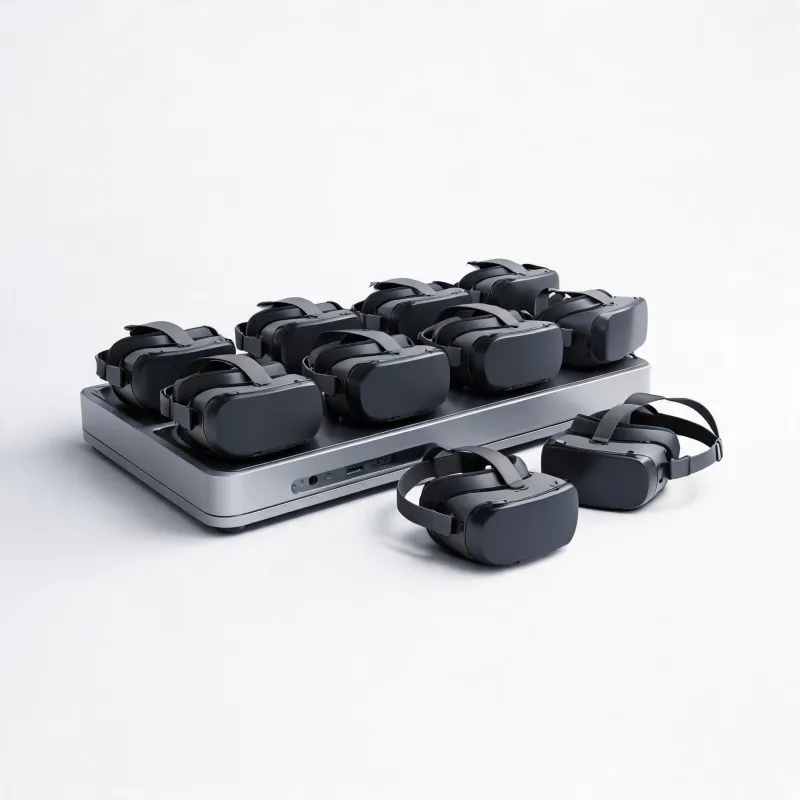
Photo: enterprise VR headsets charging dock office deployment, via img.pljz.site
Every enterprise VR pitch deck in America seems to end the same way: a rendering of employees in headsets, a nod to reduced training costs, and a slide titled 'The Future of Work.' What almost never appears is a spreadsheet accounting for what happens after the purchase order is signed. The hardware was approved. The pilot launched. And eighteen months later, the headsets sit in a charging cart outside a locked conference room in a regional office nobody visits.
This is not a failure of imagination. It is a failure of arithmetic.
The Sticker Price Is a Down Payment
Consider a representative mid-market deployment: 50 users across three US offices, running on current-generation standalone headsets. At roughly $1,000 per unit once you step up to enterprise-grade models with proper warranties, the hardware alone approaches $50,000. Add enterprise device management licenses, which most headset manufacturers now require for fleet administration, and another $10,000 to $15,000 quietly accrues over a standard three-year lifecycle.
But the number that decides these programs' fate is rarely on any quote. It is the total cost of ownership — the full burden of keeping a fleet alive inside an IT environment that never asked for it.
Where the Money Actually Goes
Break down a realistic 50-user deployment over three years and the line items multiply quickly:
- Fleet replacement and repair. Consumer-grade optics and straps were not engineered for daily rotation among strangers. Expect 15 to 25 percent attrition, whether through dropped units, facial-interface wear, or battery degradation. Budget $8,000 to $12,000.
- Hygiene and consumables. Disposable face covers, UV sanitation cabinets, and alcohol wipes are unglamorous but non-negotiable in shared environments. Roughly $3,000 over the lifecycle.
- IT administration. Mobile device management enrollment, certificate rotation, OS update windows, and help desk tickets. Even a fraction of a sysadmin's time — call it 10 hours a month at loaded US labor rates — adds $15,000 or more across three years.
- Physical logistics. Secure storage, charging infrastructure, and shipping between sites. Facilities teams charge for this, even if no one budgets for it.
- Content maintenance. The training module built for last year's headset OS will break. Recertification and rebuild cycles routinely consume $20,000 to $40,000 over the same period.
Stack it up, and a program that looked like a $50,000 purchase behaves like a $120,000 to $150,000 commitment. For a company with a few hundred million in revenue, that is not an experiment. It is a capital decision that must survive the CFO's scrutiny — and most never do.
Why Mid-Market Programs Stall Before ROI
Here is the uncomfortable part: the return on investment conversation never happens because the program dies in the cost conversation. A training director champions the pilot. Procurement approves the headsets. Then IT discovers that 50 untethered devices represent an attack surface, a compliance question, and a support burden all at once. The pilot limps along on enthusiasm until the champion changes roles, and the charging cart becomes expensive furniture.
This pattern is especially pronounced in the US mid-market, where dedicated immersive technology teams are rare and IT departments are already stretched thin. Large enterprises can absorb the overhead with specialized staff. Mid-sized companies cannot, and the economics reflect it.
The Quiet Rise of the Software-First Alternative
Meanwhile, a competing strategy is winning the same budgets with almost none of the friction: augmented reality delivered through devices employees already carry. Smartphone-based AR requires no sanitation protocols, no charging carts, no MDM enrollment, and no procurement cycle beyond an app store listing.
The experience is admittedly less enveloping. A phone screen cannot replicate the presence of a well-designed headset session. But for a surprising share of enterprise use cases — product visualization, guided workflows, remote expert assistance, spatial annotations on real equipment — the fidelity gap matters far less than the deployment gap. A program that actually runs beats a program that would have been better if it had survived.
This is not an argument that headsets lack a future. Certain training scenarios — hazardous equipment operation, high-stakes procedural rehearsal — genuinely benefit from full immersion, and the hardware improves every year. It is an argument about sequencing. Software-first AR lets organizations build spatial content libraries, internal expertise, and user habits at low risk. Headset programs then inherit an audience and a workflow instead of starting from zero.
A More Honest Framework
Organizations serious about immersive technology should ask three questions before any hardware discussion begins. First, who owns these devices operationally on day 400, not day one? Second, what is the three-year cost including labor, not just licenses? Third, could the underlying objective be met with a phone, a tablet, or a web-based 3D experience at one-tenth the overhead?
Immersive experiences earn their place through discipline, not spectacle. The companies succeeding with enterprise VR today are the ones who priced the whole truth before they bought the hardware — and the ones who realized that sometimes the most immersive thing you can deploy is the one that actually ships.