Designing for Every Body: Closing the Accessibility Gap in Immersive Experiences
Immersive technology has always sold itself on a simple promise: step inside. But for a substantial share of the American public, the door to that inside never opens. Headsets that assume two functioning hands, gesture interfaces that demand precise motor control, motion-heavy experiences that trigger vestibular distress — these are not edge cases. They are design defaults, and they exclude tens of millions of people.
The Scale of the Exclusion
The CDC estimates that roughly one in four adults in the United States lives with a disability. Add to that the aging population — a demographic with disposable income and increasing appetite for digital engagement — and the population of users navigating vision loss, limited mobility, hearing impairment, or motion sensitivity becomes impossible to ignore.
Yet walk the floor at any VR showcase or scroll through an agency portfolio, and you will find the same assumptions baked into nearly every experience: a headset that must be worn seated or standing, controllers requiring bilateral dexterity, subtitles treated as an optional checkbox, and interaction models built around reach and grab.
Why Accessibility Becomes an Afterthought
The reasons are rarely malicious. They are structural.
First, immersive projects are typically commissioned as marketing or brand experiences with aggressive launch deadlines. Accessibility reviews, when they happen at all, are squeezed into the final sprint — the same sprint where bugs get triaged and features get cut.
Second, the industry lacks mature tooling. Web design has WCAG guidelines, automated auditors, and decades of case law. Immersive design has no equivalent consensus, leaving teams to improvise standards on their own.
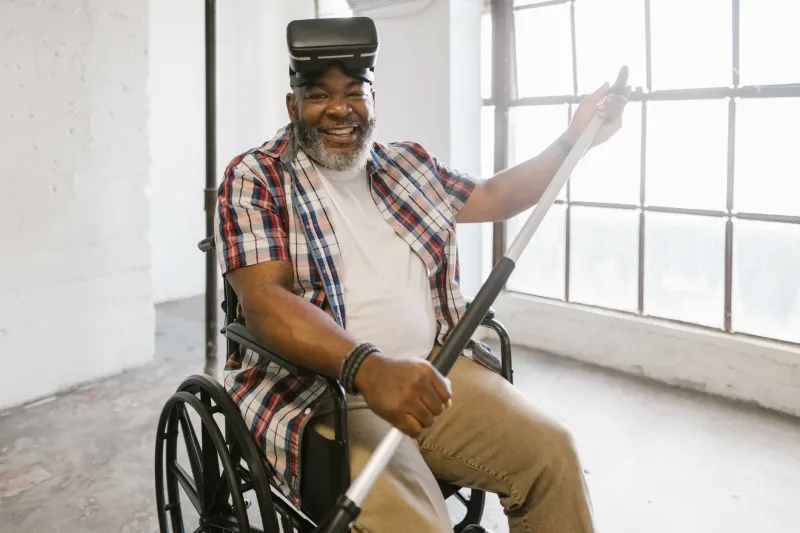
Third, there is a persistent myth that immersive experiences are inherently inaccessible — that a headset is, by definition, a barrier. In practice, the opposite can be true. A well-designed VR experience can offer scale, perspective, and interaction that no physical space can match for a user with limited mobility. The barrier is not the medium; it is the design decisions made within it.
The Legal and Commercial Reality
American businesses should not need reminding that the ADA applies to digital experiences, and courts have increasingly agreed. While landmark cases have centered on websites, plaintiff firms are watching emerging channels closely. An immersive experience launched to national audiences is, functionally, a public accommodation — and treating it otherwise is a growing liability.
The commercial argument is equally direct. Designing for accessibility broadens the addressable audience, improves usability for everyone, and signals brand values that resonate with American consumers, a majority of whom report preferring companies that prioritize inclusion.
A Practical Checklist for Inclusive Immersive Design
Teams do not need to wait for formal standards to act responsibly. The following baseline should be part of every immersive brief:
- Multiple input pathways. Support controller, gaze, voice, and switch-based input so no single motor ability is required.
- Comfort modes by default. Offer teleportation locomotion, adjustable movement speed, vignetting, and seated modes from the first launch — not buried in settings.
- Captioning and audio descriptions. Treat spatial audio as an enhancement, never the sole carrier of information.
- Adjustable visual contrast and text sizing. Headset users include people with low vision; small, low-contrast UI text is a silent exclusion.
- Session length flexibility. Allow users to pause, save, and resume — fatigue and chronic pain do not follow a demo script.
- Real-user testing. Recruit testers across the disability spectrum during prototyping, not after launch.
- Documented accessibility scope. Put inclusion requirements in the statement of work so they survive budget pressure.
Inclusion as a Design Discipline
The agencies that will define the next decade of immersive work are not the ones with the flashiest demos. They are the ones that treat accessibility as a creative constraint — the kind that produces better, more universal design. Presence should not be a privilege. Build accordingly.