The Mismatch That Kills Deals: When Studio Sprints Meet Enterprise Timelines
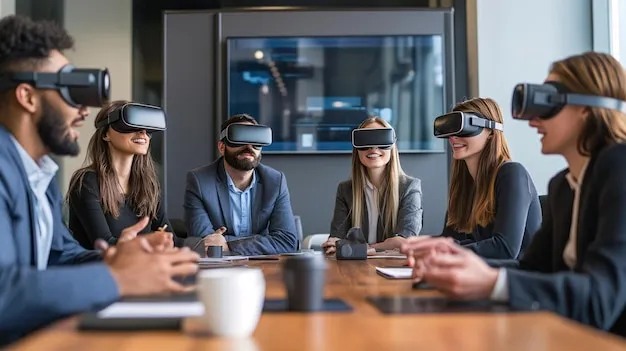
Photo: corporate boardroom VR headset presentation meeting professionals, via img.freepik.com
There is a familiar rhythm to the modern immersive pitch. A studio receives an inquiry from a Fortune 500 brand, spends two feverish weeks building a dazzling WebAR or VR proof of concept, and presents it in a conference room in Chicago or a Zoom call to a marketing team in Dallas. The room lights up. Executives lean forward. The demo does exactly what demos are built to do: it wins the moment.
And then, frequently, nothing happens for three months.
Two Clocks, One Project
The immersive design industry runs on sprint culture. Studios pride themselves on velocity — a working prototype in ten business days, a polished concept in a fortnight. This pace is a genuine competitive advantage in a market where attention is the scarcest resource, and it reflects the craft's software origins: iterate fast, fail cheap, ship early.
Enterprise buyers, however, operate on a different clock entirely. Procurement cycles at large US corporations routinely span a quarter or more. Legal review, security assessments, budget approvals, stakeholder alignment, fiscal-year planning — these are not obstacles to the deal; they are the deal. A two-week prototype is often presented to an organization that will need six months to say yes, and another six to deploy.
The mismatch is not merely logistical. It is psychological, and it is where immersive initiatives go to die.
The Expectation Debt Problem
A dazzling rapid prototype creates what we call expectation debt: a gap between what stakeholders experienced in the pitch and what the deployment phase can realistically deliver. The demo ran on a high-end headset in a controlled environment. The rollout will run on whatever devices the workforce already owns, behind enterprise security policies, integrated with legacy systems, and maintained by an internal team that did not build it.
When the eventual pilot underperforms the prototype — slower load times, narrower device support, a fraction of the visual fidelity — the reaction is rarely 'the conditions changed.' It is 'the promise changed.' And in enterprise relationships, broken promises are more expensive than missed opportunities.
We have watched this pattern repeat across retail, healthcare, and manufacturing clients. The prototype sells a vision. The deployment inherits the debt. By the time the program reaches a steering committee, the ROI conversation is happening in the shadow of unmet expectations rather than in the light of demonstrated value.
Toward a Pacing-Aware Pitch
The answer is not to slow down the craft. Speed remains a virtue. The answer is to decouple the pace of building from the pace of committing. We propose a manifesto for pacing-aware pitch processes:
1. Demo the roadmap, not just the artifact. Pair every rapid prototype with a deployment timeline that names the constraints ahead: device strategy, integration requirements, security review. Show stakeholders the delta between demo conditions and production conditions before they fall in love.
2. Match prototype fidelity to decision stage. A concept video or lightweight interactive mock may serve an early procurement conversation better than a fully rendered experience. Reserve maximum fidelity for the moment the buyer is evaluating build quality, not possibility.
3. Budget for the valley. Enterprise immersive programs almost always pass through a trough — the phase where the demo magic meets operational reality. Build that trough into the proposal, with milestones and success metrics that survive it.
4. Assign a procurement counterpart. Studios speak sprint; enterprises speak quarters. Someone on the pitch team should be fluent in both, translating velocity claims into deployment commitments the client's legal and IT teams can actually sign.
5. Treat the prototype as a contract. Whatever the demo shows — performance, accessibility, device coverage — becomes the floor for production, not the ceiling. If the prototype cannot honor that, say so in the room.
The Long Game
There is a certain romance to the two-week miracle, and we understand its appeal. Immersive design is at its best when it surprises people — when a room full of skeptical executives suddenly sees what spatial computing could mean for their brand. That surprise is worth protecting.
But the agencies that endure will be the ones that learn to pair spectacle with patience. The enterprise buyer who signs a nine-month contract does not need to be dazzled twice. They need to be guided once, honestly, through the entire distance between the demo and the deployment.
Fast prototypes win pitches. Pacing-aware processes keep clients. Studios that master both will find that the slowest part of the enterprise sales cycle — the waiting — becomes the most valuable conversation they ever have.